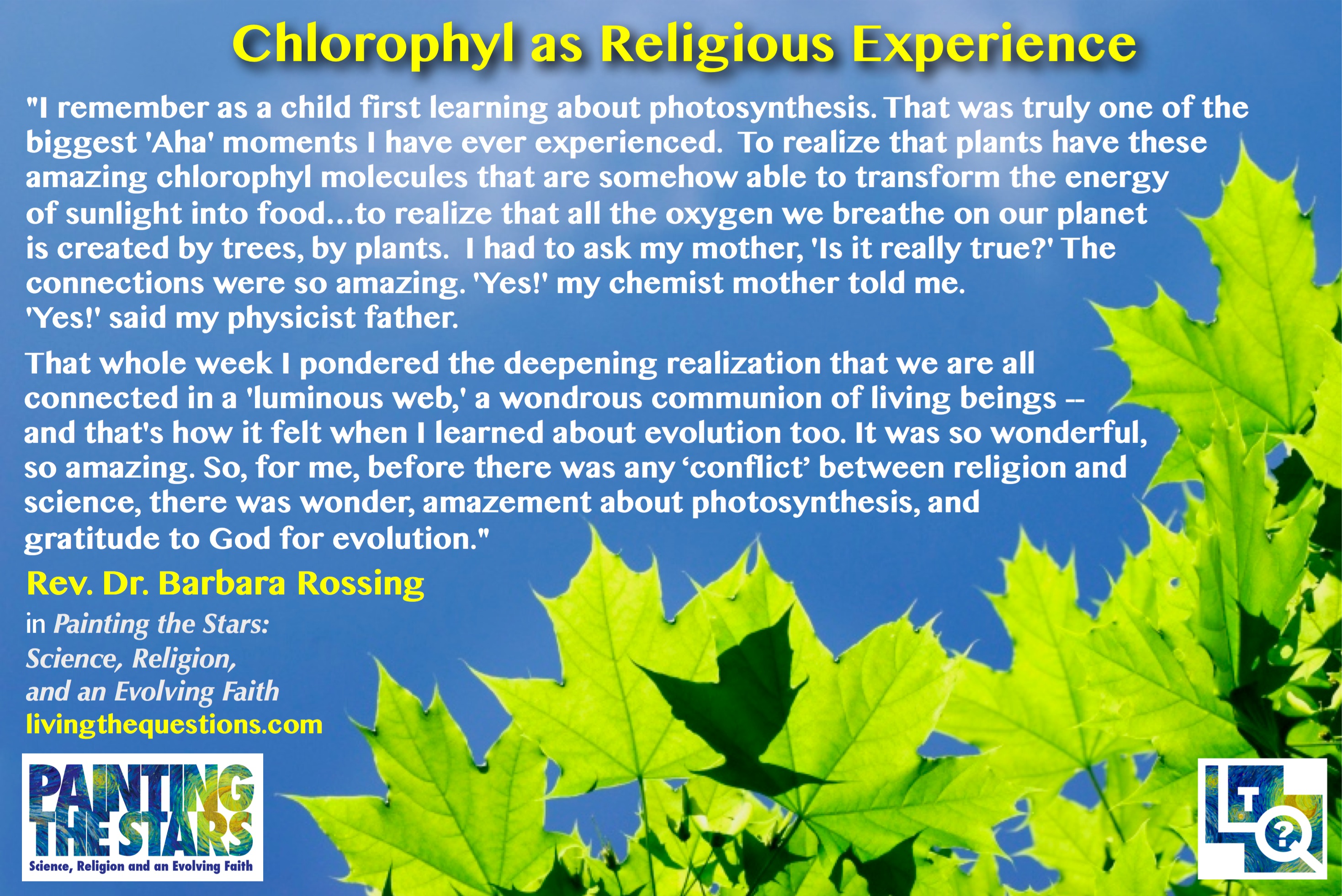
“I remember as a child first learning about photosynthesis. That was truly one of the biggest ‘Aha’ moments I have ever experienced. To realize that plants have these amazing chlorophyl molecules that are somehow able to transform the energy of sunlight into food…to realize that all the oxygen we breathe on our planet is created by trees, by plants. I had to ask my mother, ‘Is it really true?’ The connections were so amazing. ‘Yes!’ my chemist mother told me. Yes!’ said my physicist father.
That whole week I pondered the deepening realization that we are all connected in a ‘luminous web,’ a wondrous communion of living beings — and that’s how it felt when I learned about evolution too. It was so wonderful, so amazing. So, for me, before there was any ‘conflict’ between religion and science, there was wonder, amazement about photosynthesis, and gratitude to God for evolution.”
Celebrating the communion of science and faith, Painting the Starsfeatures over a dozen leading theologians and progressive thinkers in a seven-session program that explores the promise of evolutionary Christian spirituality.
Living the Questions contributor, Rev. Dr. Barbara Rossing
Barbara Rossing is Professor of New Testament at the Lutheran School of Theology at Chicago. Her publications include The Rapture Exposed: The Message of Hope in the Book of Revelation, a critique of fundamentalist “Left Behind” theology and articles and book chapters on ecology. She serves on the executive committee and council of the Lutheran World Federation, where she also chairs the Lutheran World Federation’s theology and studies committee. She has contributed to a number of Living the Questions series, including Living the Questions 2.0and Saving Jesus Redux
Don’t miss John Shuck’s “Religion for Life” interview with David Felten, one of the co-creators of Living the Questions:
Click HERE or on the graphic above to listen to the podcast
Among a variety of topics in this podcast, Felten and Shuck discuss how clergy have not been honest with laity about what is being taught in seminary and academia and how hesitant many clergy are at letting the cat out of the bag about the Jesus of history. This is part of Shuck’s current series on The Future of Faith featuring interviews with Marcus Borg, Val Webb, Lloyd Geering, Matthew Fox, and many others.
If you’ve ever been in conversation and had to fumble to try and describe exactly what “Progressive” Christianity is, then you’ll find some succinct answers in this wide-ranging conversation.
Religion For Life is an educational program that explores the intersection of religion, social justice and public life. It features interviews with local and national figures from a variety of religious traditions and from a variety of perspectives, and addresses the effects of religion – both positive and negative — on public life.
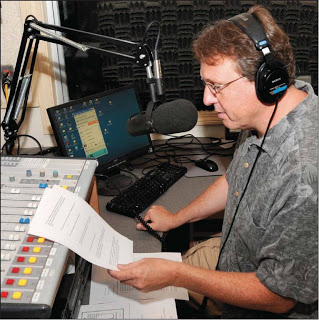
The host of the program is the Reverend John Shuck, a Presbyterian minister for 21 years and currently the minister at the First Presbyterian Church of Elizabethton, Tennessee. Prior to entering the ministry, Shuck was a radio broadcaster at stations in Boise, Idaho and Seattle, Washington. Shuck’s website is HERE and podcasts are available by heading over to PODOMATIC.
In Southern California at the end of July? Then join author, pastor, and co-creator of Living the Questions, Rev. David Felten on Monday, July 29th and Tuesday, July 30th at Pilgrim UCC in Carlsbad for practical insights on a Progressive approach to 21st century Christianity.
Ever struggled with questions about how Christianity is going to survive in an increasingly secular world – or whether it should survive? How do we justify the expense of maintaining brick and mortar churches when Jesus’ call to peace and justice are struggling to get any traction in our communities? For some surprising insights and practical tools to help tease out some possibilities, we’ll be spring-boarding off of four Biblical stories you thought you knew, but probably don’t!
Co-creator of Living the Questions, Rev. David Felten, was interviewed this week for the nationally syndicated radio show, “Culture Shocks” with Rev. Barry Lynn. Lynn is an ordained UCC pastor, constitutional lawyer, noted activist, and longstanding civil libertarian. For over twenty years, he has served as the executive director for Americans United for the Separation of Church and State, a nonpartisan organization dedicated to preserving the constitutional principle of church-state separation as the only way to ensure religious freedom for all Americans. David serves on the board of his local chapter of AU in Phoenix, Arizona. The interview was aired on Monday, June 10th and will be available streaming online by clicking on the graphic above or HERE, the Culture Shocks website.
Bernard Brandon Scott doesn’t need a personal God — he needs people…
“I get people who say, ‘Well, don’t you need a personal God?’ I don’t have a problem with God language; I have a problem with the reification of God language. God language is the way we talk about these ultimate values, for me. I don’t need a personal God. I DO need other people to relate to — and it’s that relationship with other people that is God. Now, that won’t pass the creedal test, but I’m not worried.”
Vocabulary note:
“Reification” = from Latin res “thing” + facere “to make.” Reification can be loosely translated as “thing-making;” the turning of something abstract into a concrete thing or object.
Also known as concretism (or the fallacy of misplaced concreteness), reification is a fallacy of ambiguity, when an abstraction (abstract belief or hypothetical construct) is treated as if it were a concrete, real event, or physical entity. In other words, it is the error of treating as a concrete thing something which is not concrete, but merely an idea. For example: if the phrase “fighting for justice” is taken literally, justice would be reified.
Bernard Brandon Scott is Darbeth Distinguished Professor of New Testament at the Phillips Theological Seminary in Oklahoma. He is a charter member of The Jesus Seminar, co-chair of the Bible in Ancient and Modern Media Section of the Society of Biblical Literature, and a consultant to the American Bible Society experimental film translations. He is the author of a number of books, including Re-Imagine the World, Hear Then the Parable, and The Trouble with Resurrection.
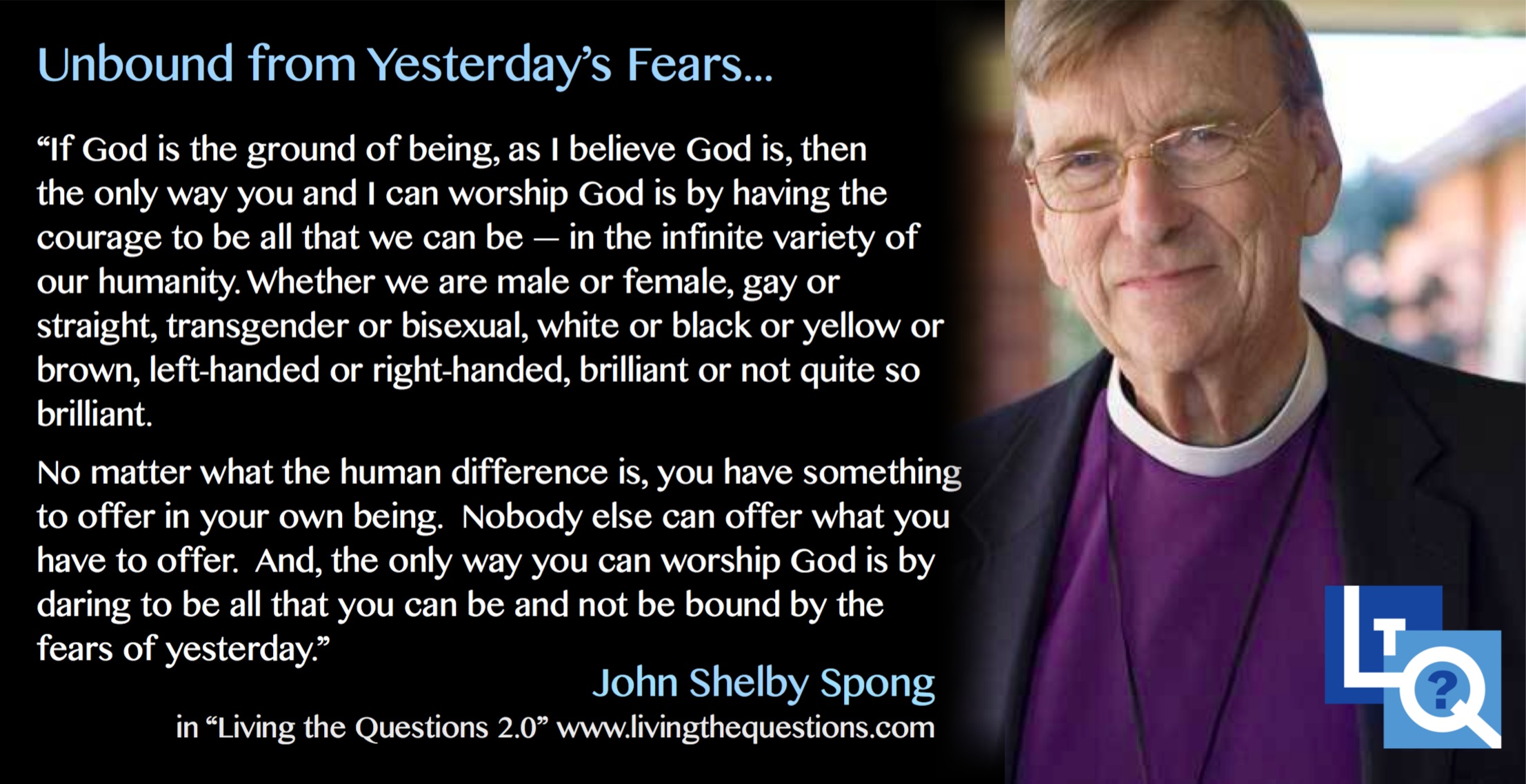
“If God is the ground of being, as I believe God is, then the only way you and I can worship God is by having the courage to be all that we can be — in the infinite variety of our humanity. Whether we are male or female, gay or straight, transgender or bisexual, white or black or yellow or brown, left-handed or right-handed, brilliant or not quite so brilliant.
No matter what the human difference is, you have something to offer in your own being. Nobody else can offer what you have to offer. And, the only way you can worship God is by daring to be all that you can be and not be bound by the fears of yesterday.”
The retired Bishop of Newark, New Jersey, John Shelby Spong is one of the featured contributors in several Living the Questions series. He is a columnist and author of over sixteen books including Rescuing the Bible from Fundamentalism and Why Christianity Must Change or Die. Lecturer at Harvard, Humanist of the Year, and a guest on numerous national television broadcasts including The Today Show, Politically Incorrect with Bill Maher, and Larry King Live, Bishop Spong continues to write and lecture around the world. His newest book is The Fourth Gospel: Tales of a Jewish Mystic.
Ever feel like Jesus has been kidnapped by the Christian Right and discarded by the Secular Left? Then you need Saving Jesus, a 12-session DVD-based exploration of a credible Jesus for the third millennium — now available for home use! This remarkable series features nearly 30 thought leaders at the forefront of Progressive Christianity, including Marcus Borg, Diana Butler Bass, John Dominic Crossan, Yvette Flunder, Matthew Fox, Amy-Jill Levine, Brian McLaren, Stephen Patterson, Helen Prejean, John Shelby Spong, & more!
Stephen Patterson thinks that Progressive Christianity is about “being willing to think critically about one’s faith and about the traditions of one’s faith and the resources like the Bible — to think critically about these things and not simply assume that it all has to make sense. Progressive Christianity means you’re free to explore and to question and to develop new expressions of faith that are more appropriate or true to what you think you’re discovering about Christianity. So, Progressive Christianity, I guess you could say, is Christianity that’s not stuck in some present stasis — let alone stuck in the past. We have to move forward.”
Progressive Christianity:
thinks critically about faith, traditions, and resources
doesn’t assume it all has to make sense
frees one to explore and question
develops new expressions of faith more appropriate to contemporary understandings
isn’t stuck in the past
Stephen J. Patterson specializes in the study of the historical Jesus, Christian origins, and the Gospel of Thomas (an early Christian gospel not found in the New Testament). He is currently the George H. Atkinson Professor of Religious and Ethical Studies at Willamette University. He is the author of numerous books including Beyond the Passion: Rethinking the Death and Life of Jesus and The God of Jesus: The Historical Jesus and the Search for God.He is featured in the DVD series Living the Questions 2.0andSaving Jesus Redux.
“Thinking Critically with Stephen Patterson” is an excerpt from a DVD series on the origin of the Bible currently in development by Living the Questions.
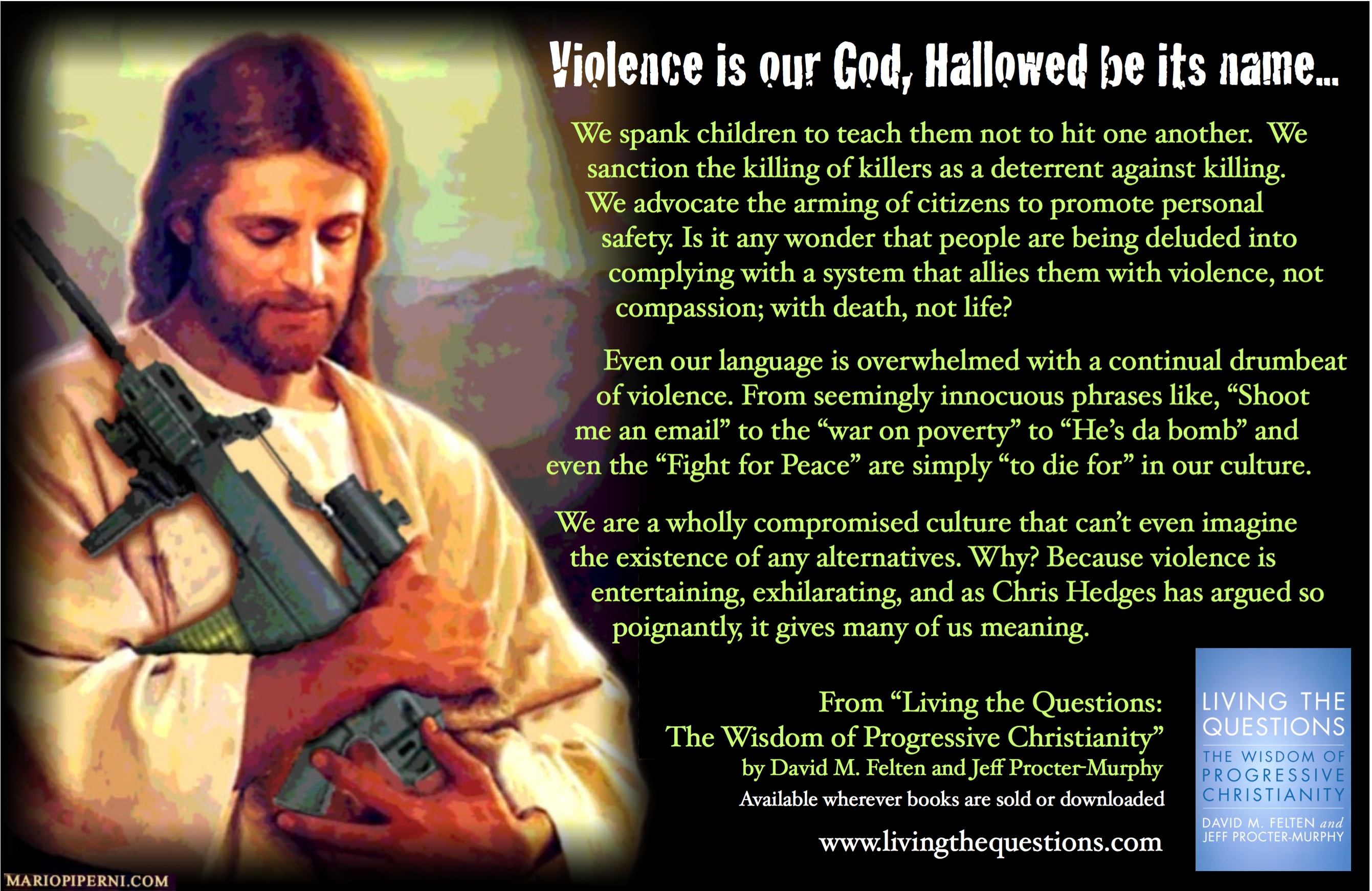
We spank children to teach them not to hit one another. We sanction the killing of killers as a deterrent against killing. We advocate the arming of citizens to promote personal safety. Is it any wonder that people are being deluded into complying with a system that allies them with violence, not compassion; with death, not life?
Even our language is overwhelmed with a continual drumbeat of violence. From seemingly innocuous phrases like, “Shoot me an email” to the “war on poverty” to “He’s da bomb” and even the “Fight for Peace” are simply “to die for” in our culture.
We are a wholly compromised culture that can’t even imagine the existence of any alternatives. Why? Because violence is entertaining, exhilarating, and as Chris Hedges has argued so poignantly, it gives many of us meaning.
From “The Myth of Redemptive Violence” in
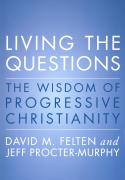
Living the Questions: The Wisdom of Progressive Christianity
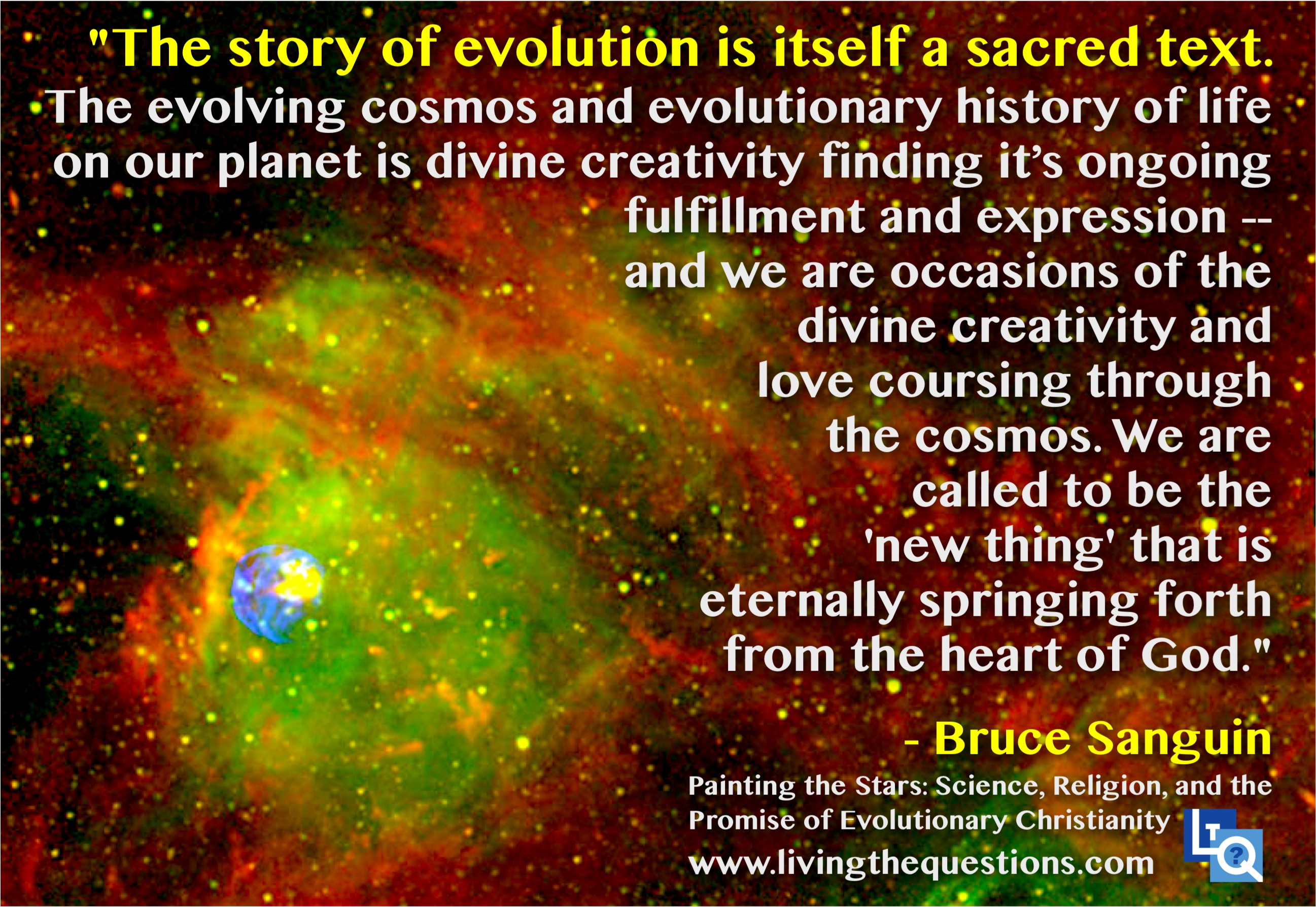
Bruce Sanguin understands evolution as a divine strategy for making a world that can make itself, and that God is in the business of alluring all of creation into the deep enjoyment of realizing the highest possible expression of goodness, truth, and beauty.
“Everything and everybody is involved in a sacred, evolutionary process, including the Christian faith. What might it look like for a church to consciously embrace and celebrate the “blessed unrest” that is coursing through us as a work of Spirit? We have more questions than answers at this point, and that’s part of the adventure.”
As a Christian, Sanguin believes the Heart and Mind of God–that which was in Jesus–is incarnate in every bit of this blessed universe and planet of ours. Along with the rest of life, we need to creatively adapt to changing life conditions, or suffer the evolutionary consequences — which we’re seeing with the decline of the mainline churches. The crisis that we’re going through right now on the planet could very well be birth of a new reality. This creative adaptation and innovation is driven by Spirit. It’s up to us to be part of the evolution.
Rev. Bruce Sanguin is the Minister of Canadian Memorial United Church and Centre for Peace in Vancouver, B.C. He is a leader in evolutionary Christianity, teaching evolutionary theology and practice with a passion for updating the theology and practice of the church in light of the reality of evolutionary processes and the creative impulse of the universe.
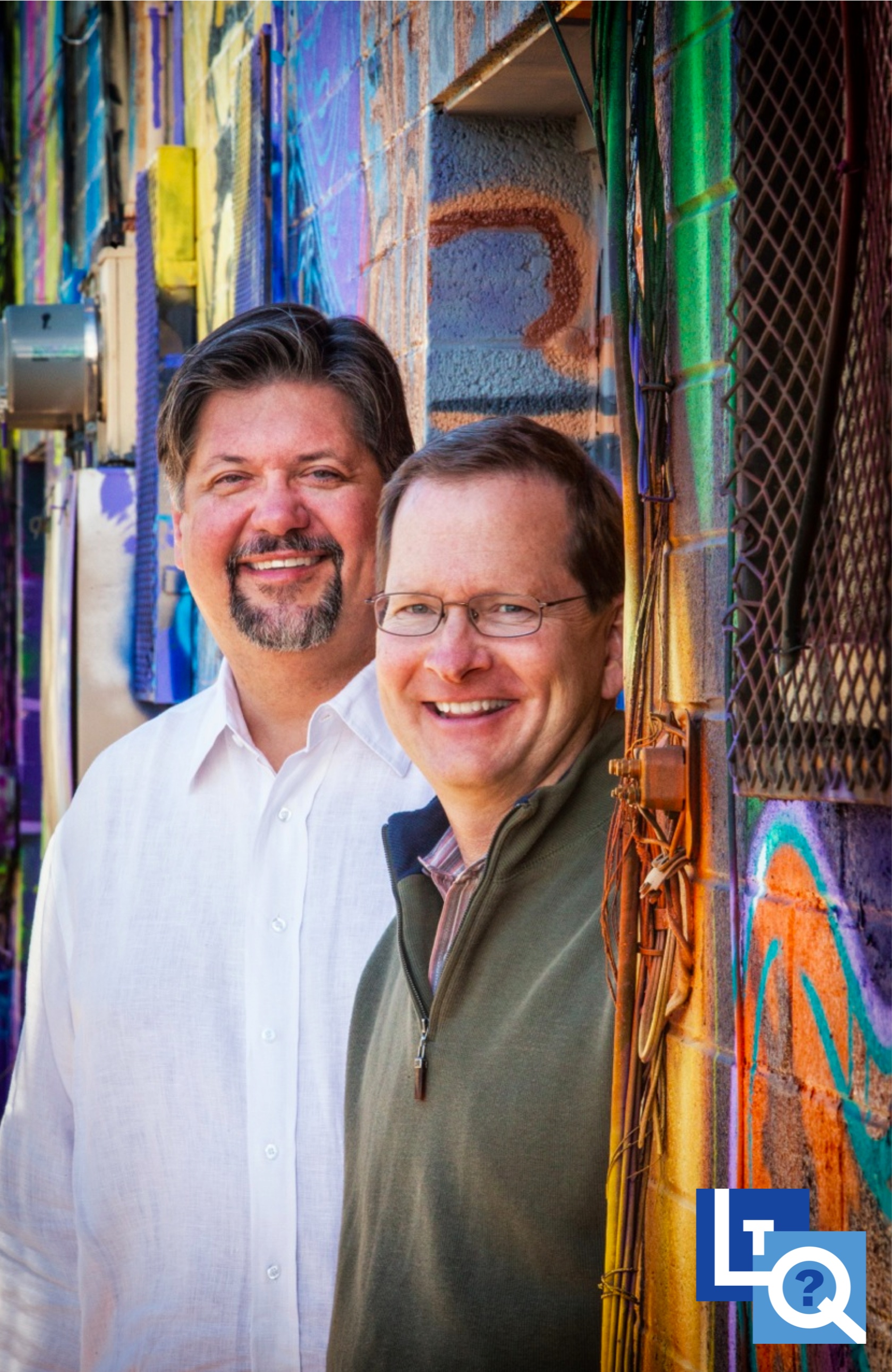
Pastors David Felten and Jeff Procter-Murphy, along with the voices of top Bible scholars and church leaders—including Marcus Borg, Diana Butler Bass, John Dominic Crossan, Helen Prejean, and John Shelby Spong—provide a primer to a church movement that encourages every Christian to “live the questions” instead of “forcing the answers.”
Based on the bestselling DVD course, "Living the Questions: The Wisdom of Progressive Christianity" tackles issues of faith, dogma, and controversial subjects that many churches are afraid to address. "Living the Questions" is the most comprehensive survey of progressive Christianity in existence today.
Available at www.livingthequestions.com, through online booksellers, and as a Kindle download!
“A welcome book that is bold (without being contentious) and courageous (without needing to be triumphant), Felten and Procter-Murphy give voice to a faith that provides a profound alternative to the dominant ideology of ‘American Christianity.’ Attention should be paid!”
— WALTER BRUEGGEMANN, PROFESSOR EMERITUS, COLUMBIA THEOLOGICAL SEMINARY









 Living the Questions
You must be logged in to post a comment.